
In our previous blog, we explained how many carbohydrates you need during exercise. In this blog, we zoom in further on those carbohydrates. Why are carbohydrates so important during exercise? What types are there? And how does your body process them? We explain it step by step.
What exactly are carbohydrates?
Carbohydrates are molecular compounds made up of carbon, hydrogen and oxygen atoms. They form chains ranging from just a few to hundreds of thousands of monosaccharides. That may sound like chemistry, but in simple terms a carbohydrate is a chain of different sugars. The smallest unit of such a carbohydrate chain is called a monosaccharide, and there are three important ones: glucose, fructose and galactose.
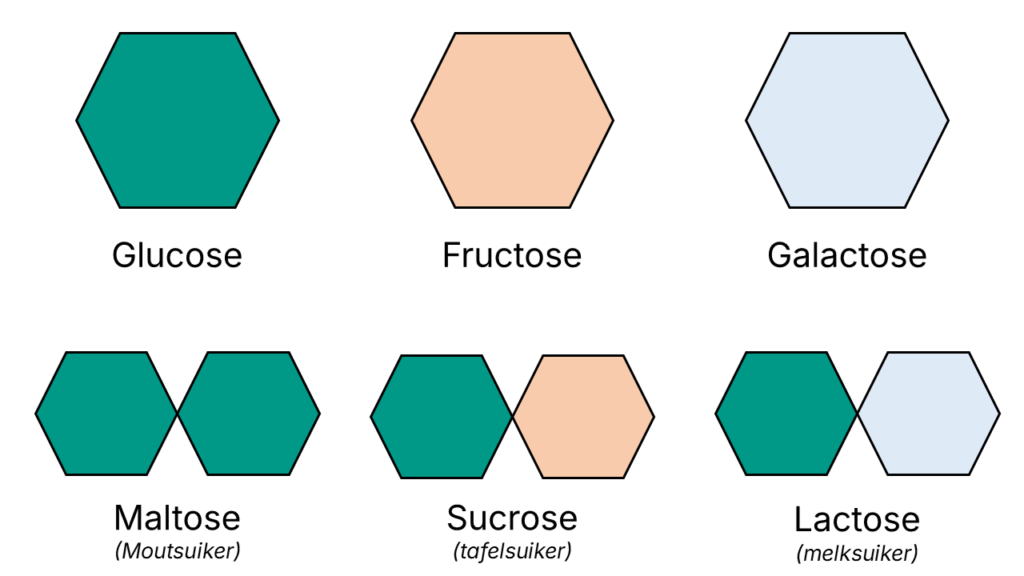
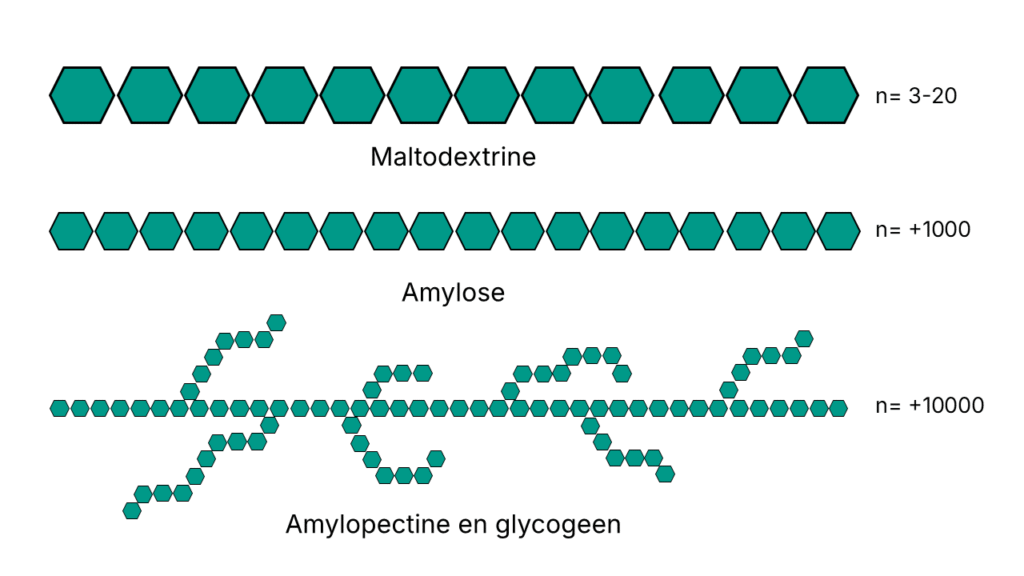
These three form the basis of most carbohydrates as you know them from your plate. Combine 1 glucose and 1 fructose and you get sucrose. That may sound complicated, but we simply know it as table sugar. Combine 1 glucose and 1 galactose and you get lactose, or milk sugar. These sugars made up of 2 units are called disaccharides. If you link multiple glucose units together and form a chain of 3 to 20 units, you get maltodextrin. A well-known carbohydrate for most athletes.
Make the chain even longer, with thousands of glucose units, and you have amylose. If the chain also has branches, we call it amylopectin. These longer chains are called polysaccharides, or starches and complex carbohydrates. There are also even longer chains that the body digests less well. These fall under fibres such as cellulose and pectin. Many wholegrain products contain a mix of complex carbohydrates, long sugar chains, and fibres.
Sources of carbohydrates
Many people already know this, but carbohydrates are mainly found in plants. Fruit, for example, contains many short sugar chains, as do some vegetables such as pumpkin and cabbage. Potatoes and grains contain the longer chains, complex carbohydrates or starch. Rice, pasta, wheat, oats and other grains are important sources of complex carbohydrates. More information about carbohydrates can be found at the Voedingscentrum.
Digestion
During carbohydrate digestion, the chains are gradually broken down. This process already starts in your mouth through an enzyme called amylase. In the small intestine, the long chains are further broken down into monosaccharides. The sugar units are then absorbed through the intestinal wall by means of transporters. Glucose is absorbed by SGLT1 transporters and fructose by GLUT5 transporters, more on that in a future blog. How easily you digest and absorb a carbohydrate partly depends on the length of the chain. The longer the chain and the more branches it has, the longer it takes to turn it into monosaccharides. We then speak of a complex or multiple carbohydrate. Digestion takes longer and the energy is released more slowly into the body.
As humans, we cannot digest fibres ourselves, but bacteria in our intestines can. Fibres also slow gastric emptying and intestinal passage, which means the digestion and absorption of other nutrients also happen more gradually. Table sugar and sugars in sweets and soft drinks are very short and are therefore digested and absorbed into the blood much faster, causing a much higher spike in blood sugar. After all, a lot of sugar is broken down and absorbed by the intestines in a short period of time.
Glycaemic index
How quickly a carbohydrate is broken down and absorbed therefore mainly depends on the length and branching of the chains. This is reflected in the glycaemic index, or GI, a system that allows us to classify carbohydrates based on how quickly they are absorbed by the body. Products with a high GI are absorbed very quickly, such as the short sugar chains in soft drinks and sweets. Products with a low GI are digested slowly and consist of longer chains, such as many wholegrain products. For more information on this topic, visit the Voedingscentrum.
Carbohydrate storage
Once sugars enter your bloodstream, they are used in different ways. Some are burned by your cells, while the rest is stored by your body. This can happen in your liver or muscles in the form of glycogen, but if these stores are full, we store the sugars as fat. Glycogen is actually comparable to a starch. It is a long chain of glucose units that we can break down again when we need energy. We mainly do this during exercise.
During exercise
In our previous blog, we explained that we need a lot of energy during exercise. Normally, we mainly burn fats, but as soon as intensity increases and the demand for energy rises, we switch to carbohydrates. Fat burning is too slow to release a lot of energy in a short time. The carbohydrates stored in the liver, in the form of glycogen, are broken down again and the separate glucose units travel through the blood to the muscles.
We do this because carbohydrate combustion is much faster and more effective as soon as the demand for energy increases. We break down the glycogen chains and use the separate glucose units as fuel to keep our engine running.
However, our glycogen supply is limited. We can keep this going for a while, but once exercise lasts longer than an hour, we run into trouble. The supply runs out and we no longer have enough energy to maintain the intensity. That is when you hit the wall.
You always want to avoid that kind of energy crash. You do not want to suddenly have to slow down during exercise because your energy stores are empty. And this is exactly where sports nutrition comes in. Fast energy that you can easily absorb and use directly for combustion: the short carbohydrates glucose, fructose and maltodextrin. Most sports nutrition consists of these three sugars because we absorb them easily during exercise.
Your intestines during exercise
During exercise, blood flow to the gastrointestinal tract is reduced. The body gives priority to the working muscles, the heart and the skin. As a result, the digestive and absorption capacity of the intestines decreases. At that point, it is not practical to process long carbohydrate chains. Those long chains first need to be broken down before they can be absorbed. A stomach full of pasta or wholegrain bread will not feel comfortable and your intestines will protest.
Sports nutrition consisting of short sugar chains is therefore ideal. Short carbohydrate chains such as glucose, fructose and maltodextrin are broken down and absorbed more quickly. This puts less strain on the gastrointestinal system and makes them more suitable during exercise. Do note that if you take a lot of gels or sports drink, you can still experience intestinal discomfort. The absorption capacity of the small intestine is limited to about 60 grams of glucose per hour. If you take more, the glucose remains in the intestines for longer and that can cause problems.
In this blog, we took a deeper look at carbohydrates: what they are and how you digest them. In the next blogs, we will discuss hydration, fluids and electrolytes.