

In the previous blog, we laid the foundation: the body is an engine, and you want to keep it running. During sport, you continuously use carbohydrates as fuel. The longer and more intense the effort, the faster your internal stores decline. In this blog, we look at how many carbohydrates you need, how the body can absorb them and which forms of sports nutrition fit that purpose.
Start with a full tank
On normal days, the carbohydrate requirement for athletes is around 3 to 5 grams per kilogram of body weight per day. That is approximately 900 to 1500 kcal from pure carbohydrates and is enough for daily functioning and light training. When you train for a longer or more intense effort, that changes. Then you want to start with well-filled glycogen stores. This is often referred to as carbohydrate loading or carbo-loading. Depending on training load and race duration, intake can rise to 5 to 12 g of carbohydrates per kilogram of body weight per day in the days leading up to a race. The goal is simple: start with the largest possible tank.
How many carbohydrates during sport?
For efforts shorter than one hour, carbohydrate needs are limited. The body has enough glycogen to meet the demand. Often, less than 30 grams per hour is sufficient, and if the intensity is low, no intake may be needed at all. What can work, even at low intensity, is mouth rinsing. This involves rinsing the mouth with a carbohydrate solution. The sugars activate receptors in the mouth that stimulate the reward centre in the brain 1. As a result, the body senses that energy is on the way, which can make the effort feel lighter and improve performance, even without actually ingesting carbohydrates.
For efforts lasting 60 to 120 minutes, the need increases. Glycogen stores then start to run down more quickly. Guidelines then suggest 30 to 60 grams of carbohydrates per hour to replenish glycogen stores and delay fatigue.
When exercise lasts longer than two hours, replenishment becomes crucial. Most guidelines then recommend 60 to 90 grams of carbohydrates per hour, provided the gastrointestinal system has been trained for this 2.
| <60 minutes | 60-120 minutes | 120+ minutes | |
| Low | Mouth rinsing | 30 g/hour | 30-45 g/hour |
| Medium | Mouth rinsing or 30 g/hour | 30-60 g/hour | 60 g/hour |
| High | 30 g/hour | 60 g/hour | 90 g/hour |
Why transporters are the limiting factor
During exercise, your intestines become less active. More blood goes to the muscles, which means your intestines are less able to digest food properly. During exercise, it is therefore best to consume short, fast carbohydrates. Your body can digest and absorb these more easily. Because they are absorbed more quickly, they remain in your intestines for less time and are less likely to cause intestinal discomfort. However, there is a maximum: we can absorb only about 60 grams of glucose per hour.
Glucose is absorbed via the SGLT1 transporter. This transporter becomes saturated at around 60 grams of glucose per hour. For short or low-intensity exercise, it is therefore sufficient to take only glucose or maltodextrin, a long chain of glucose units, because you are still below the maximum absorption capacity of the SGLT1 transporters. Taking even more glucose, more than 60 grams per hour, does not provide extra energy, but does increase the risk of gastrointestinal complaints. The remaining glucose stays in the intestines and can cause bloating, nausea and diarrhoea.
There is also another carbohydrate: fructose. Like glucose, fructose is a monosaccharide, a short single sugar. Fructose uses a different route, via the GLUT5 transporter. By combining glucose and fructose, you use multiple transporters at the same time and increase total absorption capacity. This makes it possible to take in even 140 grams of carbohydrates per hour 3. For most athletes, however, this is still too much and can lead to intestinal discomfort.
Carbohydrate ratios
To make optimal use of these transporters, carbohydrates in sports nutrition are often combined in specific ratios. A common ratio widely used in sports nutrition is 2:1, glucose to fructose. If you aim for 90 g/hour, this comes down to 60 grams of glucose and 30 grams of fructose. This is well tolerated by many athletes. All our carbohydrate products contain this 2:1 ratio and are therefore ideal for a 90 g/hour strategy. We also use maltodextrin as a glucose source. These glucose chains are less sweet and better tolerated by the intestines than free glucose.
Recent research shows that ratios such as 1:0.8 can also be effective. You then combine 60 grams of glucose and 48 grams of fructose to reach more than 100 grams of carbohydrates per hour in total. This higher fructose intake can further increase total carbohydrate absorption, provided the gastrointestinal system is accustomed to it. In a future blog, we will take a deeper look at these differences and when each ratio makes sense.
Sports nutrition
Carbohydrates during sport can be taken in different forms. Sports drinks combine hydration with energy and are especially useful in warm weather or with high sweat losses. Gels provide concentrated carbohydrates and are practical at higher intensity. They can also be taken quickly and are easy to dose at higher intakes. Oat bars or other solid foods are more often used at lower intensity or during longer endurance sessions, so the intestines can process them properly. There are also bars, such as the Instant Energy Bar and the Chew Bar, that contain more fast sugars, making them suitable during heavier efforts as well. Think of longer races lasting several hours. These bars are also ideal if you do not tolerate gels well. Which product ultimately works best depends on the situation and personal preference.
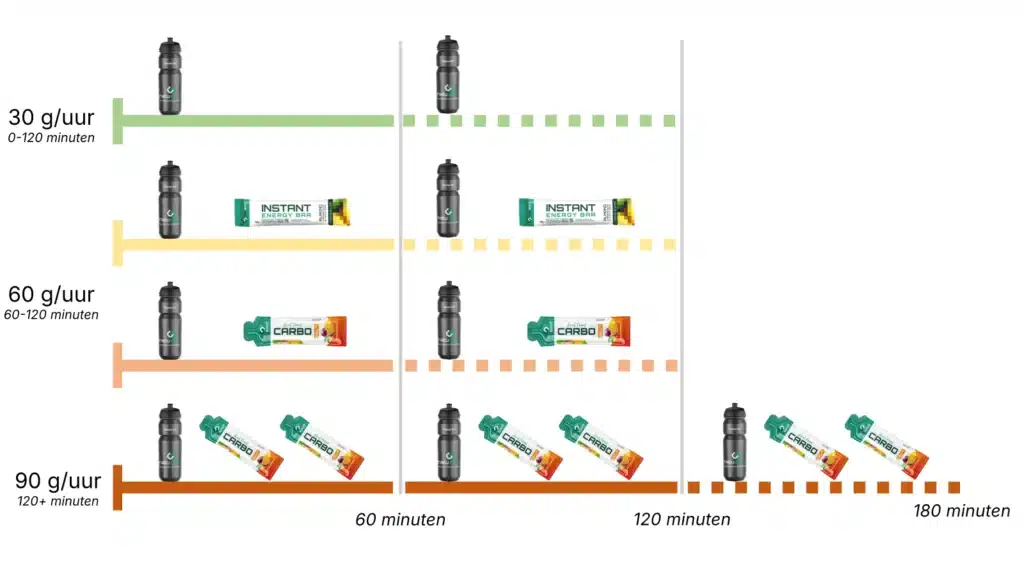
Natusport carbohydrate products contain between 20 and 40 grams of carbohydrates in a 2:1 ratio. This makes them easy to dose depending on the intensity and duration of your effort. In the schedule below, you can see how to use our sports nutrition. There are no fixed plans, only flexible combinations.
Practical tips
Do not wait until you hit the wall. Make sure you always start a training session or race prepared. Start with a full tank and bring enough sports nutrition with you. Begin your carbohydrate strategy from the start, for example by taking a gel or bar every 20 minutes. By spreading carbohydrates evenly across the effort, your energy supply remains more stable. Always combine carbohydrates with enough fluid and test your nutrition strategy well in advance during training, not only on race day.
Want to learn more about carbohydrates? In the next blog, we dive even deeper into the topic. What exactly are carbohydrates? How do we digest them? And how do we store them? After that, we will focus on hydration and the importance of fluids and electrolytes during exercise.
References
- Rollo, I., & Williams, C. (2011). Effect of mouth-rinsing carbohydrate solutions on endurance performance. Sports Medicine, 41(6), 449-461.
- Jeukendrup, A. E. (2011). Nutrition for endurance sports: Marathon, triathlon, and road cycling. Journal of Sports Sciences, 29(sup1), S91–S99.
- Jeukendrup, A. E. (2010). Carbohydrate and exercise performance: the role of multiple transportable carbohydrates. Current Opinion in Clinical Nutrition & Metabolic Care, 13(4), 452-457.